How do I review the week's shopping money without an interrogation?
Make it a ritual, not a reckoning: five minutes at the same time each week, over a record both of you can already see. When the week's top-ups, spends, and receipts were written down as they happened, the check-in confirms what the record says instead of reconstructing it from memory.
Why the money talk feels like an accusation
Most household money talks are really memory tests: what was this for, how much was that, where is the change. Reconstructing a week across a table puts both of you on the spot — you sounding like an interrogator when you mean housekeeping, her defending an ordinary Tuesday.
The problem was never the conversation. It is asking memory to be the record. Once the record exists on its own, the conversation changes shape: two people looking at the same page, not at each other.
The five-minute weekly ritual
Pick a fixed moment — Sunday evening works for many households — and keep it short: look at the cash on hand, glance down the week's spends with their receipts, agree next week's float. Five minutes, same time, every week. The regularity is what makes it feel like housekeeping instead of an audit.
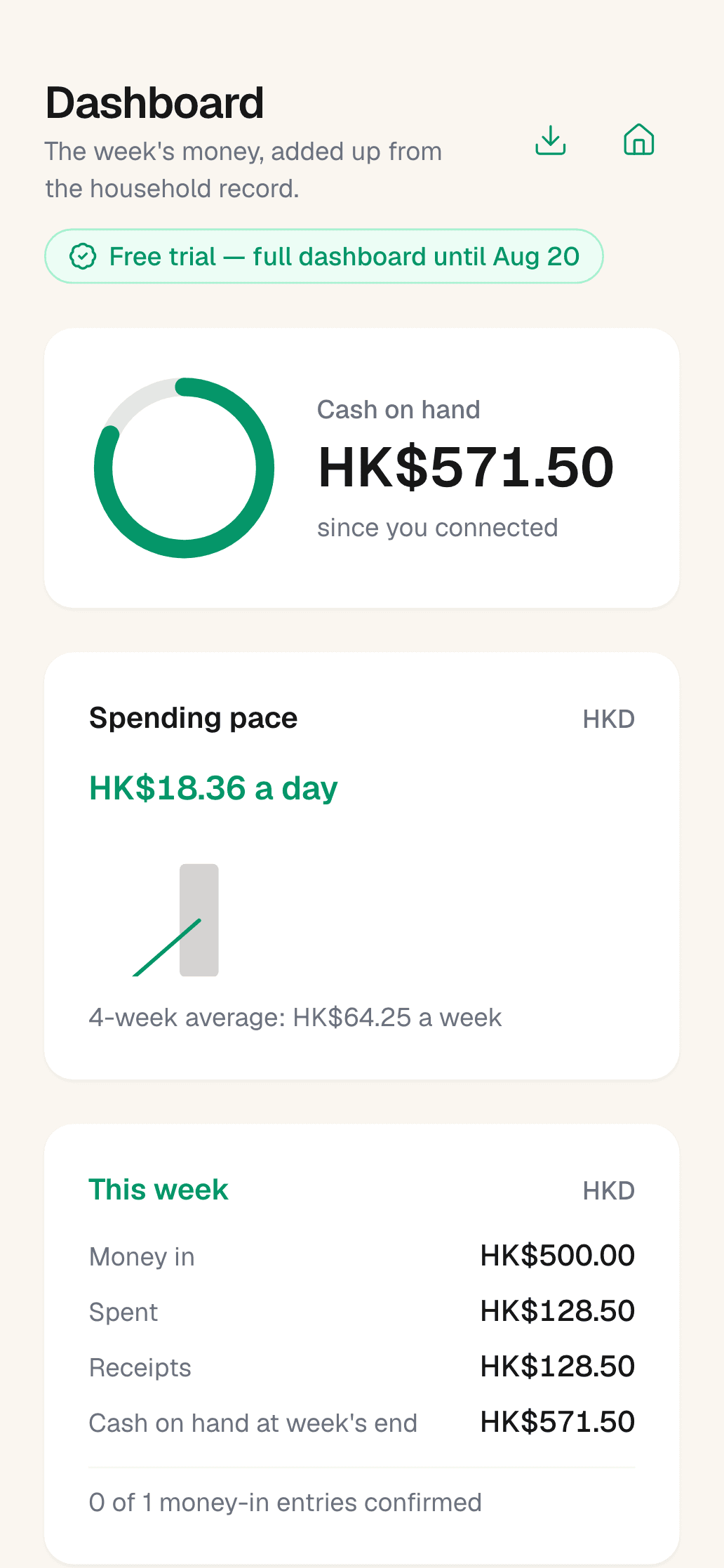
In SamaKasa the week is already added up for you: the employer dashboard shows the cash position, the spending pace, and the week’s totals against the receipts — the paid part, with a free trial inside the app. Her tools stay free forever. If the float itself needs sizing, our float-sizing guide has the method.
Keep the ritual kind
Small gaps are normal — change, rounding, a substituted item that cost more. Agree on a small threshold you both ignore, and read the week as a whole. The record works for her here too: an expensive week shows up as prices on receipts, not as doubt.
If the weekly conversation has already gone awkward in your household, the deeper fix is the record itself — our guide to keeping shopping money clear without awkward conversations starts there.
Related questions
What if the numbers do not add up exactly?
Small gaps are normal — change, rounding, a substituted item. Agree on a small threshold you both ignore, and read the pattern over weeks, never a single missing coin. Our wet-market guide covers the same rule for no-receipt spending.
Should I check the money more than once a week?
Weekly is enough when the record is current — you can glance at the shared record any time without making it a conversation at all. Daily interrogations spread the awkwardness thin; the ritual contains it.
Who keeps the record we are looking at?
She writes it — receipts, amounts, notes — and both of you see all of it. A record she authors protects her as much as it informs you; there is no hidden view on your side.
Keep this week's shopping money clear
SamaKasa is the grocery list and shared cash record built for households with a domestic helper — free for helpers, forever. One email when it is ready for your household.