How much grocery money should I give my domestic helper?
Give a weekly amount, not a monthly one: enough for a normal week of wet-market and supermarket runs, plus a small buffer for price swings and guests. The reliable way to find that number is to watch one real week of spending together, then fix the float from what you both saw.
Start from one real week, not a guess
Pick a normal week — no parties, no visitors — and let the shopping happen as it usually does. Keep every receipt and note every market spend. The total at the end of that week is your baseline, and it is worth more than any rule of thumb, because it is your household's real number.
Generic advice about what groceries “should” cost ignores the two things that move the number most: how much of your shopping happens at the wet market versus the supermarket, and how your household actually eats. One observed week captures both.
Weekly beats monthly — and beats daily
A month of cash is a month of guessing. A large monthly float makes drift invisible until the end, when raising it feels like an accusation. Daily amounts turn every market run into an errand that needs clearing first.
A weekly float sits in between: small enough that a quiet week and an expensive week are easy to tell apart, large enough that she can shop without asking permission at a stall. The top-up becomes a small, regular ritual — the same day each week, the same way — instead of a reckoning.
Write the float down where both of you can see it
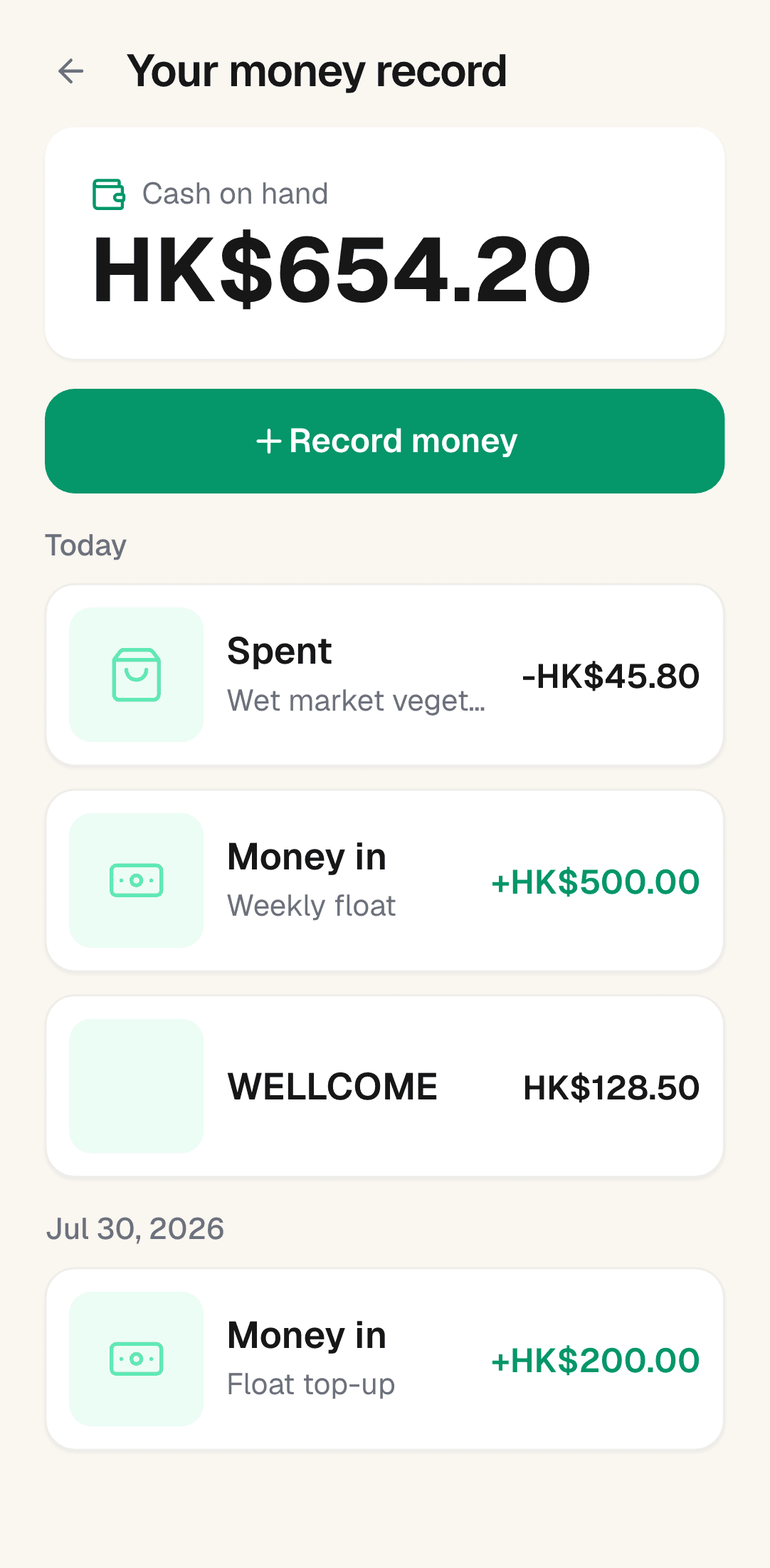
Whatever number you land on, it only stays clear if its record lives in one place: what was given, what was spent, and what is left. SamaKasa keeps exactly this record — top-ups, spends, and receipts in one running ledger that both of you see, in English and Filipino.
Because she writes the record, it protects her as much as it informs you: an expensive week shows up as prices on receipts, not as a question mark.
Related questions
What if the money runs out before the week ends?
Treat it as information, not suspicion: prices move, guests arrive, a stall runs out and the substitute costs more. Top up, note it in the same record, and if it happens two or three weeks running, raise the float. In SamaKasa the top-up lands in the same ledger both of you see.
Should the float cover more than groceries?
Decide explicitly, and write it down once. Most friction comes from scope — whether the float covers cleaning supplies, the rice sack, or the odd delivery fee — not from the amount itself. A clear scope makes a clear week.
What about wet-market spending, where there are no receipts?
Note the amount at the stall, while it is fresh — our guide to wet-market spending without receipts covers the habit in detail.
Keep this week's shopping money clear
SamaKasa is the grocery list and shared cash record built for households with a domestic helper — free for helpers, forever. One email when it is ready for your household.