What do I do when the wet market gives no receipts?
You cannot collect a printed receipt at most wet-market stalls, so capture the spend another way: the amount, noted at the stall while it is fresh, in a record both of you can see. The habit that keeps household money clear is freshness, not paper.
Why the wet market is where trust breaks
Supermarkets print receipts; wet-market stalls usually do not. That gap is why the market run is the part of household shopping most likely to cause friction — not because anyone is dishonest, but because nothing on paper says what the fish cost.
Left unrecorded, small gaps grow into big doubts. Employers start preferring chain stores just for the paper trail; helpers feel questioned over a bag of vegetables. The fix is not avoiding the wet market — for freshness and price it is often the best place to shop. The fix is giving the spending a record.
Capture the amount at the stall, not at home
Memory is the real leak. An amount written down at the stall is accurate; the same amount reconstructed at home is a guess. SamaKasa is built for exactly this moment: snap the stall's price board or the handwritten note if there is one — and when there is nothing to photograph, type the amount yourself, right there.
Everything saves on the phone first and syncs when the connection returns, so a basement shop or a concrete market block never breaks the record.
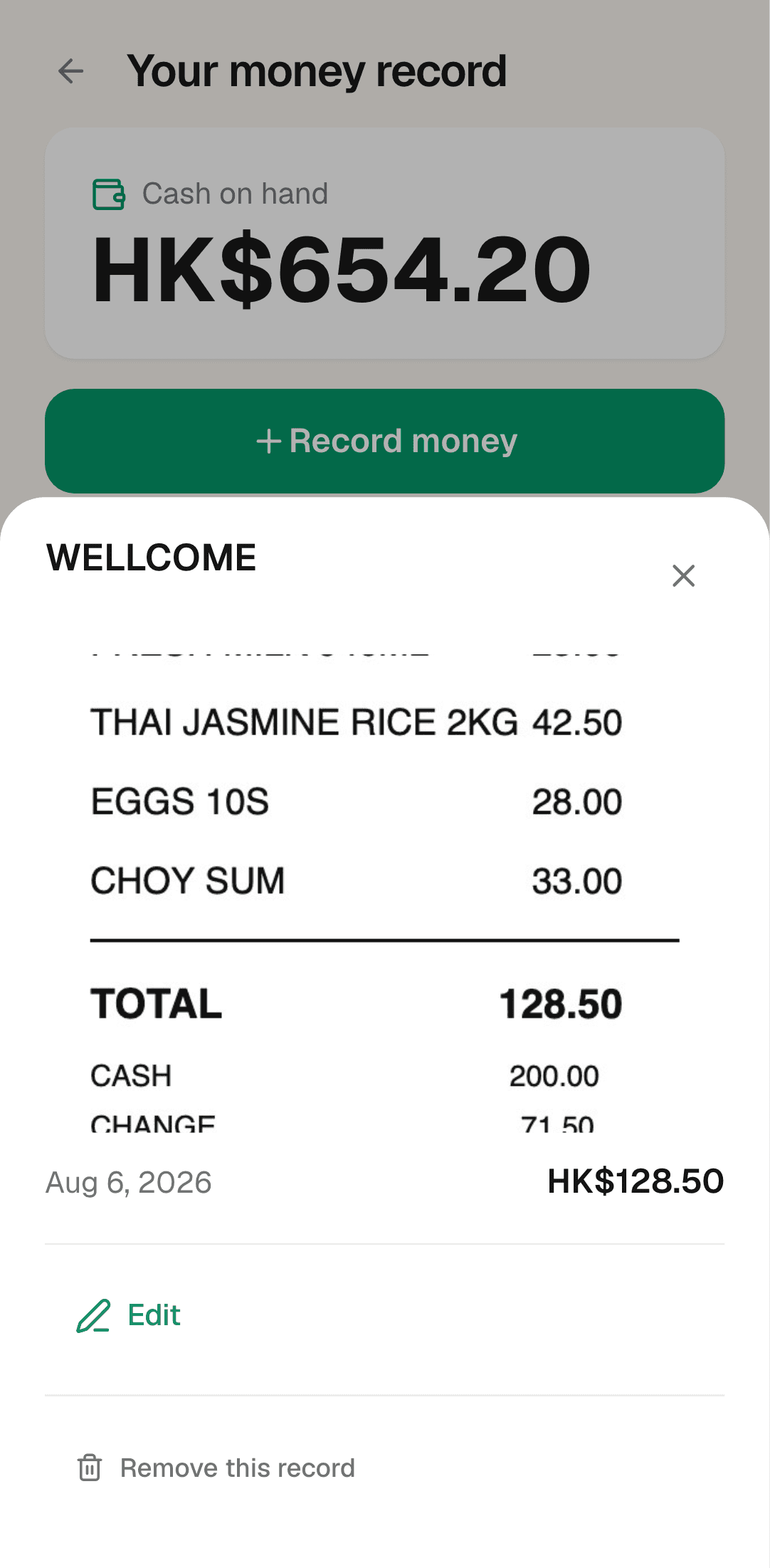
Agree once on how no-receipt spending gets noted
Decide together, once, what a good market note looks like: the amount, what was bought, and a photo when there is something to photograph. After that, nobody has to improvise — the method is settled, and the record shows it was followed.
Walking the first few market runs together helps as well: you learn the real prices at her stalls, she learns what you care about, and the shared baseline makes every later week easier to read.
Related questions
Is a photo of a handwritten note really enough?
For household money, yes: the question is where the money went, answered while it is fresh. The point is the shared record, not legal-proof paper.
What if the amounts do not add up exactly?
Small gaps are normal — change, rounding, a substituted item. Agree on a small threshold you both ignore, and read the week as a whole: the pattern over weeks is what matters, never a single missing coin.
Should I walk the market with her at first?
If you can, once or twice. Shared price baselines turn later weeks from guesswork into pattern-reading — and the record keeps that baseline alive.
Keep this week's shopping money clear
SamaKasa is the grocery list and shared cash record built for households with a domestic helper — free for helpers, forever. One email when it is ready for your household.