Should my helper carry cash or an e-wallet for shopping?
Either works, because the payment rail was never the real problem. What employers want from an e-wallet float is a record they can check anytime — and cash plus a shared, written-down ledger gives you exactly that, without moving the money onto a second system someone has to manage.
The e-wallet advice is really about the record
The standard employer advice is to replace the cash float with a dedicated Octopus or e-wallet, so that every transaction can be checked anytime. Read it closely: the goal is the checking, not the card. The payment rail is just the means the advice had at hand.
That distinction matters, because it means you are not choosing between trust and control — you are choosing between two ways of getting a record. One way changes the money. The other changes what happens to the information.
A dedicated e-wallet is a second system to run
A float on a card or in an app does not maintain itself. Someone has to top it up, check its balance, keep the app working, and notice when it runs dry mid-shop. In most households that someone is your helper — the e-wallet moves the record-keeping onto her, inside a system you do not share.
And the float still needs explaining. A card balance tells you what left the account; it does not tell you what the money bought, or why Tuesday cost more than Monday. The questions a cash float raises do not disappear — they just move into an app only one of you can see.
Cash plus a shared record gives you both
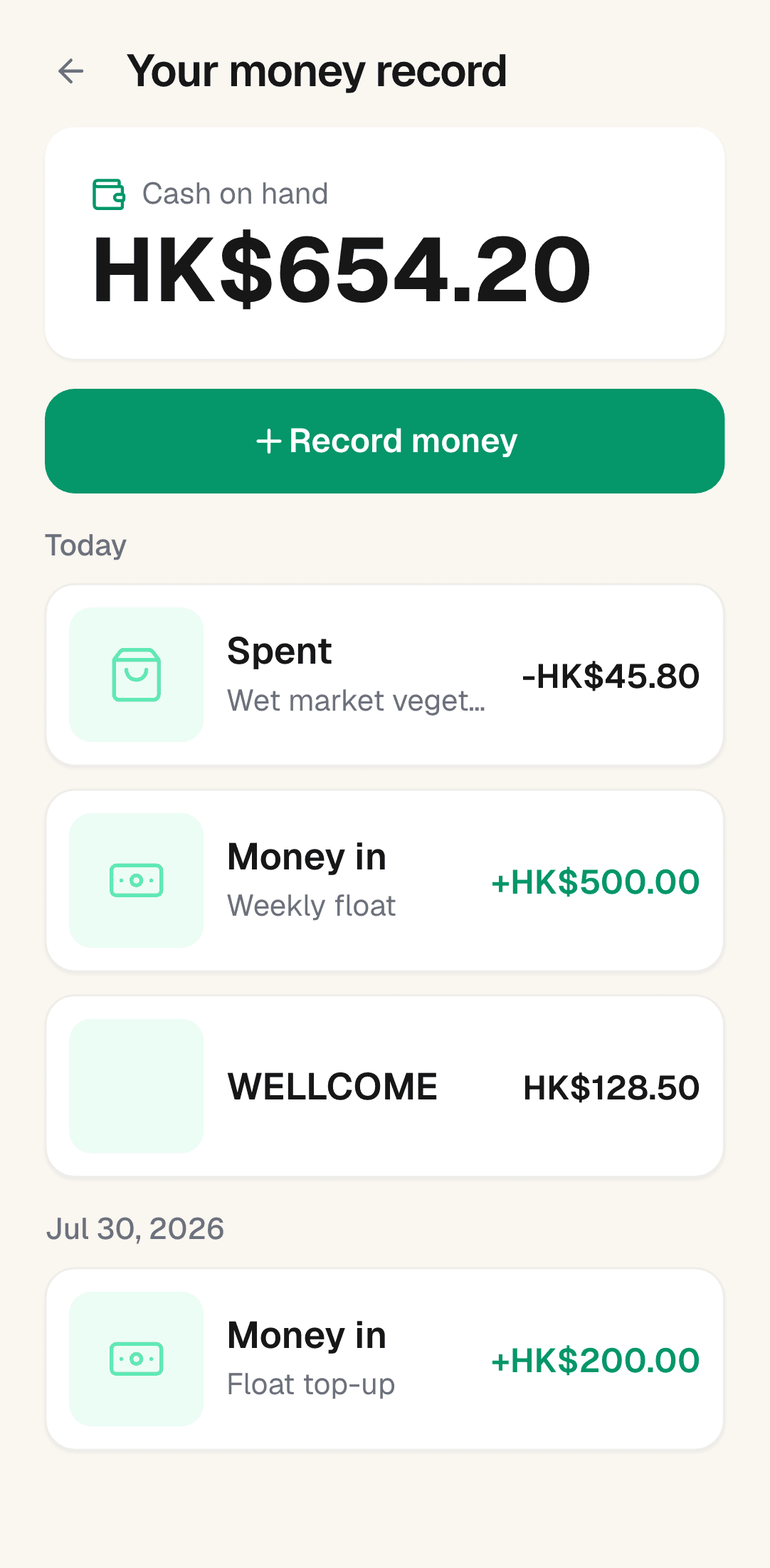
Keep the money simple and make the record shared. In SamaKasa the float stays cash — handed over the same day each week — and the record lives where both of you can see it: every top-up, every spend, every receipt, and the cash-on-hand position that adds them up.
She writes the record, so it protects her as much as it informs you — an expensive week shows up as prices on receipts, not as a question mark. For sizing the float itself, see our grocery-money guide.
Related questions
Isn't cash easier to lose track of than a card?
Unrecorded money is easy to lose track of — on any rail. A card balance records that money moved; a shared ledger records what it was for. The record is the control, whichever way the money travels.
Should the float sit in her personal e-wallet?
Mixing household money with personal money recreates the exact opacity the e-wallet advice was trying to remove. However the float is held, keep it identifiable as household money — a known amount, a known purpose, a shared record.
What about wet-market stalls that give no receipts?
Note the amount at the stall, while it is fresh — the habit is the same whether the float is cash or card. Our wet-market guide covers it in detail.
Keep this week's shopping money clear
SamaKasa is the grocery list and shared cash record built for households with a domestic helper — free for helpers, forever. One email when it is ready for your household.