Can I trust handwritten receipts?
A handwritten receipt is only as doubtful as the gap between the stall and the record. Captured at the stall — photographed if there is paper, typed in if there is not — the amount becomes a shared record both of you see while it is fresh, and 'easy to alter' stops being the point.
Where the anxiety comes from
The employer playbook says it plainly: a handwritten receipt is easy to alter and hard to verify, so cautious households drift toward chain stores, where every spend comes with a printed, checkable slip. The suspicion is rarely about one note — it is about what happens to the note between the stall and home.
The cost of that drift is real. The wet market is often the freshest and cheapest place to buy dinner — avoiding it means paying more for worse food, all to buy paper. And the suspicion wears on the person doing the shopping, who knows exactly how it reads.
Freshness beats paper
A printed receipt proves a transaction happened at a chain store. It does not prove the week's money is clear. What actually clears money is an amount written down at the moment of spending, in a record both of you can see — the paper is just one way to get there.
That reframes the handwritten note from a weakness into a capture moment: snap it where it was written, and the alteration window — the walk home, the end of the week — never opens. Where there is no note at all, the same rule applies: the amount goes into the record at the stall. Our wet-market guide walks through the no-paper case.
A record written at the stall is hard to argue with later
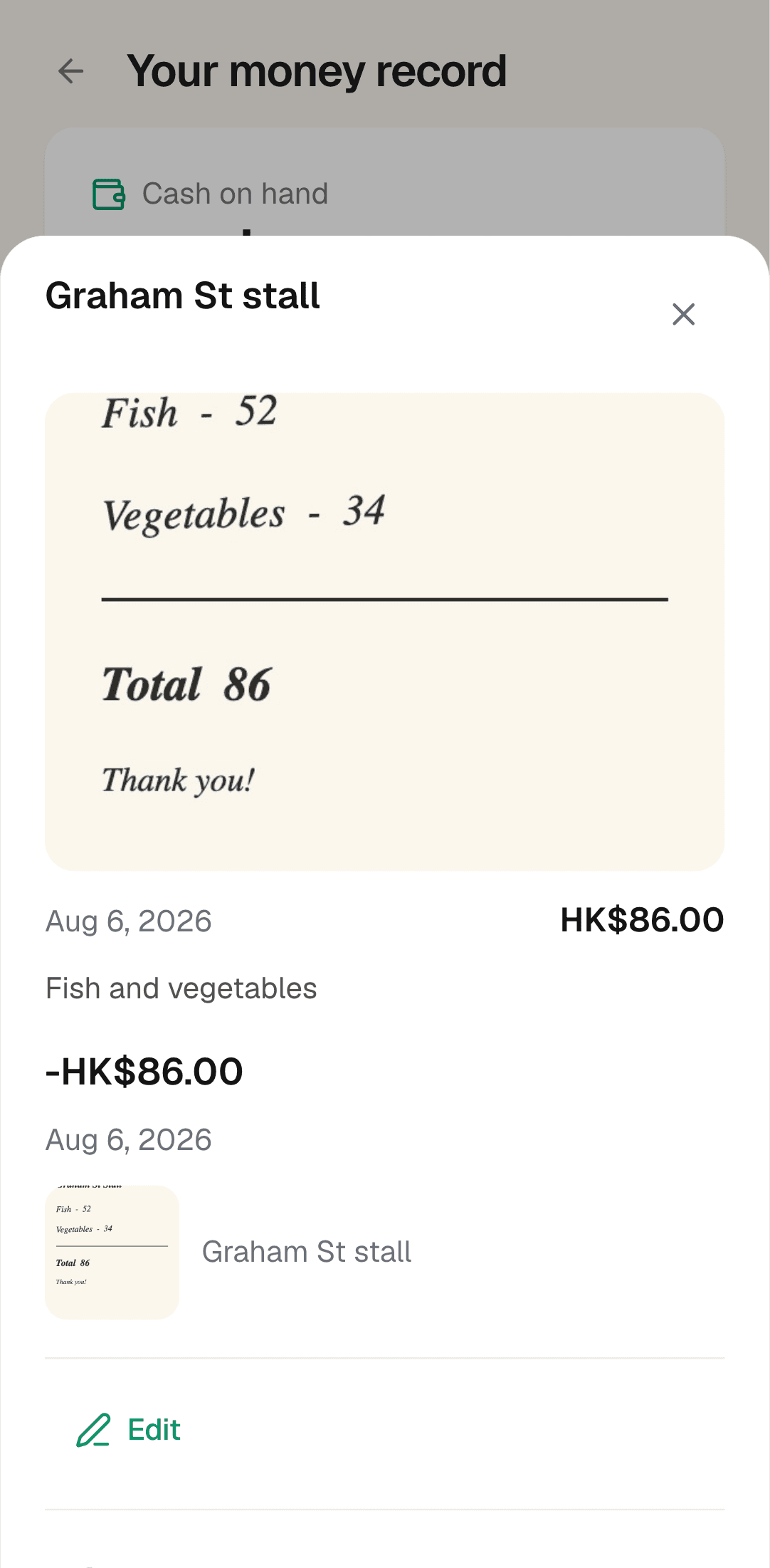
In SamaKasa your helper photographs the receipt or the handwritten note — and when there is nothing to photograph, she types the amount herself, right there, marked honestly as entered by hand. Everything saves on the phone first and syncs when the connection returns, so a concrete market block never breaks the record.
Because she writes the record, it protects her: a questioned spend has her photo and her note beside it, captured while the price was still on the stall board. For you it is the same bytes, read as oversight. That is the point — one record, both readings.
Related questions
What stops a wrong number being written down?
The same thing that stops it anywhere: a shared record read as a pattern. A single odd line stands out in a week of ordinary spends, and the record shows it to both of you — quietly, in context, instead of across a table.
Should I just ban the wet market and stick to supermarkets?
You would pay in freshness and price to buy paper — and the paper was never the real fix. Record the wet-market spend at the stall and you keep the market and the clarity.
What about the printed chain-store receipts — keep those too?
Yes — snap them the same way, so supermarket slips and market notes sit in one record. A week that lives in one place is a week you can read at a glance.
Keep this week's shopping money clear
SamaKasa is the grocery list and shared cash record built for households with a domestic helper — free for helpers, forever. One email when it is ready for your household.